The healthcare AI that outlasts AGI: own what stays scarce
A founder's map of which moats survive cheap intelligence, and which dissolve in it.
Ask most teams building healthcare AI today what their edge is, and the honest answer is the model: a sharper clinical reasoner, a better summarizer, a smarter triage agent. That answer is about to age badly. If general-purpose intelligence keeps getting cheaper and more capable, the cognition at the center of those pitches becomes the commodity, not the moat. The durable opening isn’t the thing that gets smarter when models improve; it’s the thing that stays scarce no matter how smart they get.
Let me walk through the reasoning first, then put it on a map.
“Outlasting AGI” is not about out-thinking it
Start by retiring a tempting but wrong framing. The goal isn’t to find the one healthcare task a frontier model will never master; betting against capability is how you end up with a roadmap full of soon-to-be-solved problems. The right question is narrower and more useful: when reasoning is abundant and nearly free, what is still hard to get?
Five things keep their value in that world. Regulated trust and liability, a model can produce a diagnosis, but it cannot hold a license, carry malpractice insurance, sign an attestation, or be the defendant in a lawsuit. Proprietary physical and biological data, an AGI is only as good as the inputs it can reach, and continuous sensor streams, consented biobanks, and longitudinal records of a real population are collected from the physical world, not reasoned into existence. Physical-world presence, someone still has to draw the blood, run the infusion, install the monitor, and handle the medication. Payment and compliance plumbing, reimbursement, coding, and contracts are slow, regulation-bound, and accountability-laden. And the human relationship, patients extend trust to people and institutions, not to inference.
Each of these gets cheaper to operate as intelligence improves, and none of them is the intelligence. That combination is the whole game.
Read the landscape by moat durability, not by capability
Take every health tech idea and rank it by how durable its moat remains after AGI, then decompose each idea’s barrier to entry into its components: capital and physical presence, regulation and license, proprietary data, and distribution and trust. The mix tells you what the moat is actually made of, and whether AGI can erode it.
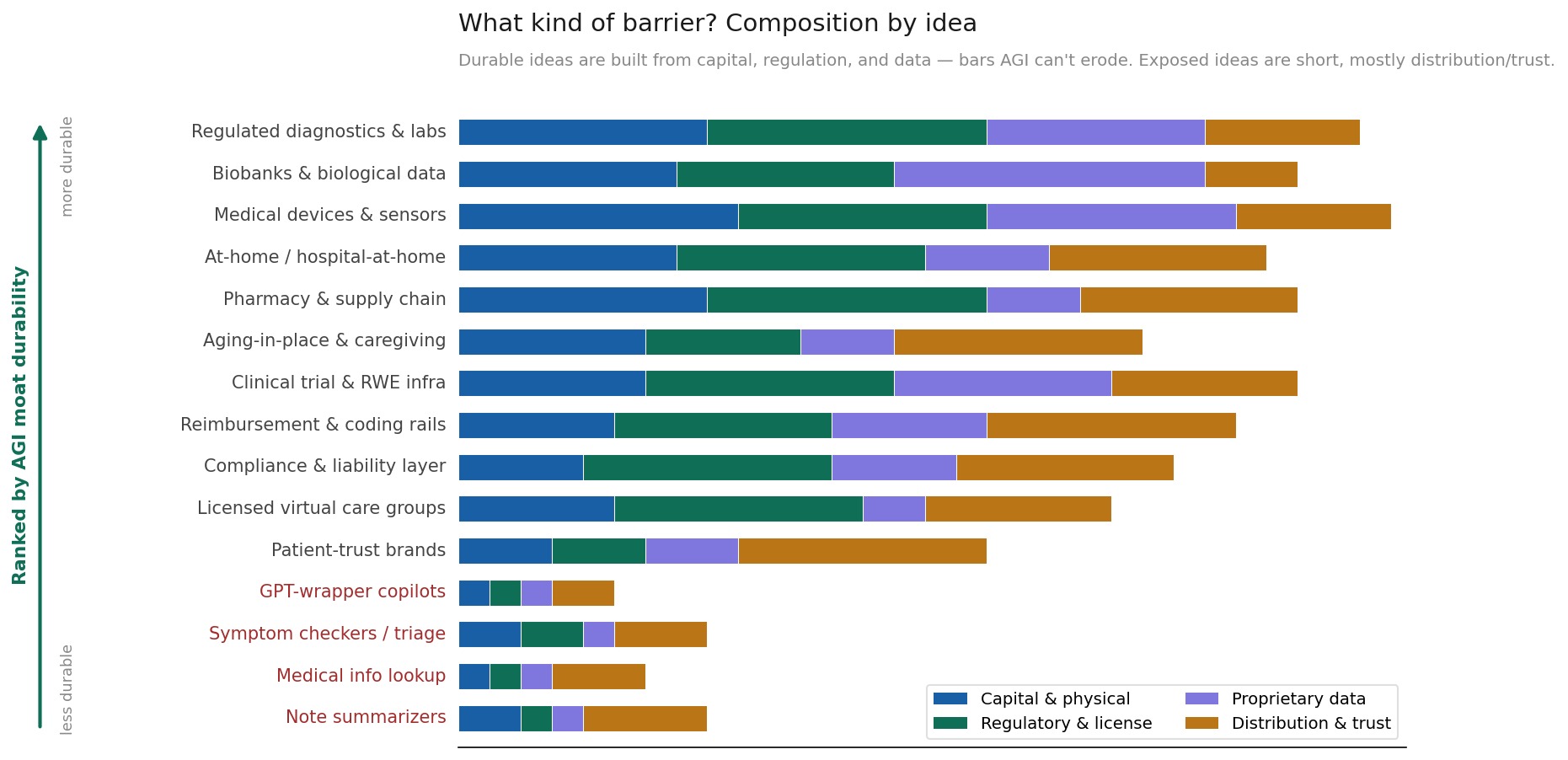
Two patterns surface immediately. The first: the celebrated software-intelligence plays, standalone symptom checkers, note summarizers, generic clinical copilots, sit at the bottom of the ranking with short bars made almost entirely of distribution and trust, because their entire barrier is the reasoning, and that’s the first thing to commoditize. The second is the trap of confusing barrier height with barrier durability. A business can be genuinely hard to stand up today and still collapse later if the hard part was cognition someone else is about to give away.
Now the encouraging pattern. The open ground sits at the top of the ranking: businesses whose long bars are dominated by capital, regulation, and proprietary data, the things that stay hard because the moat is physical, regulated, data-bound, or relational. That territory isn’t where the demos are. It’s the diagnostics lab, the device, the home visit, the biobank, the billing office, and the trusted front door.
A tension worth stating plainly: durable is not the same as capital-light. Much of that top-of-ranking group, labs, biobanks, in-person care logistics, is capital-heavy and tends to scale linearly, adding cost with every site, sample, or visit. That’s a different risk-and-return shape than the near-zero marginal cost a software investor is used to underwriting. The chart tells you where the moat is durable; it doesn’t tell you the business is venture-scale. The most attractive ideas resolve the tension: a durable physical or regulatory moat paired with a software-like margin on top, such as a proprietary data stream that compounds without compounding cost, or a regulated result whose marginal unit is cheap once the gate is cleared.
The clearest opening: own the regulated result
Begin with the moat that scores well on every axis. A company that legally issues a diagnostic result, a lab with CLIA standing, an FDA-cleared device, an entity that owns the output and the liability for it, holds something a model structurally cannot. The reasoning behind the result can be the cheapest, most capable intelligence available; the accountability for the result is the asset, and it doesn’t transfer to software.
Look at how this actually plays out. AGI makes the lab cheaper to run, the device smarter, the read faster and more accurate, and leaves the company’s defensibility entirely intact, because regulators assign accountability to licensed persons and legal entities, not to models. There’s a gate to clear, but the gate becomes the moat that shields you afterward rather than a tax that merely slows you down. Land that and you hold the rare full house: abundant intelligence as your cheapest input, sitting underneath a barrier the intelligence can never hold.
One honest caveat: this moat is durable, not static. Liability frameworks are evolving; device-software pathways are maturing, and regulators may eventually let well-validated autonomous software carry certain low-level liabilities on its own. That would erode the thinner end of the trust moat over time. It doesn’t collapse the thesis, because the highest-stakes accountability stays with licensed humans and legal entities for the foreseeable future, but it does mean the regulated-result moat is strongest where the stakes, and the liability no one wants to automate, are highest.
Where else the room is
Proprietary sensors and biological data. An AGI can reason brilliantly over data it can access and not at all over data no one has collected. The durable play is owning the collection apparatus, a novel wearable or device generating streams no competitor holds, or a consented biobank with custody of samples. The installed base becomes a flywheel: more devices, more data, a widening gap that cognition alone can’t close. Sell the substrate of scarce reality, not a model that anyone can rent.
Hospital-at-home and in-home care operations. Most care is physical, and even capable robotics doesn’t dissolve the licensing, logistics, real estate, and trust of showing up safely in someone’s home. AGI plans the visit and optimizes the route; someone still has to make the visit happen and be accountable for it. The moat is the operating capability and the license, with intelligence layered beneath.
Pharmacy and the controlled supply chain. Controlled-substance handling, cold chain, and last-mile fulfillment are physical and heavily regulated. The intelligence that routes and forecasts gets cheaper; the right to handle and dispense, and the accountability for doing it correctly, stays scarce. Compete on the regulated physical rails, not on the routing math.
Reimbursement, coding, and the compliance layer. The back-office plumbing is slow, contract-bound, and accountability-heavy, which is exactly why it endures. AGI drops the cost of operating inside payer rules dramatically, but the rails themselves and the entity that attests to correctness persist. The defensible version wires directly into EHRs and clearinghouses and owns the attestation, rather than just drafting documents a model can also draft.
The trusted patient relationship. Continuity, advocacy, and the sense that a named someone is accountable for you are themselves the product across much of care. A brand that owns the longitudinal relationship can deliver AGI-grade advice underneath while remaining the human-facing, liable front door. The advice commoditizes; the relationship and the accountability don’t.
And where not to build
By the same logic, the weakest square on the board is the one soaking up much of the attention: businesses whose entire value proposition is cognition any capable model will replicate. Standalone symptom checkers and triage chatbots, generic documentation tools with no proprietary data or workflow lock-in, thin clinician copilots that hold no license and no data, medical-information lookup with no relationship behind it, these are useful features, not durable companies. None of them is a bad product. Each shares one fatal trait: its moat is exactly the asset AGI makes abundant. To survive, every one of them has to acquire a moat from the list above: own data, own the license, own the relationship, own the physical presence, or own the rails.
One sharp exception deserves naming, because it’s where this rule gets misread. A “thin” copilot is only doomed if it stays thin. The same thin copilot, embedded seamlessly into the EHR across a large share of US health systems, owns something the model itself never will: distribution and the workflow real estate. That company can swap the cheapest, best frontier model in behind the scenes as intelligence commoditizes, and keep capturing value precisely because it holds the point of use. The lesson isn’t “never build a copilot.” It’s that the copilot is the wedge, not the moat; you have to convert early distribution into entrenched real estate before the model underneath becomes a commodity everyone else can also rent.
Distribution or data: where the value actually accrues
Two of these moats deserve to be weighed against each other directly, because they’re the two a software-native team can realistically build, and they capture value at different layers. Owning the distribution, the EHR real estate, the point of use, versus owning a proprietary data stream is the central allocation question once you’ve decided not to bet on cognition itself.
Distribution is the faster moat and, in the near term, the more defensible one. Whoever holds the point of use can rent whatever model is cheapest and best that quarter, swapping the intelligence underneath without the user ever noticing. That’s real power, and it’s why an entrenched copilot can outlast far cleverer standalone tools. But distribution is rentable in principle: it’s a position another company with deeper integration, a better contract, or the EHR vendor’s home-field advantage can contest. You’re renting out access to abundant intelligence, which means your margin is only as safe as your grip on the channel.
A proprietary data stream is slower to build and compounds rather than commoditizes. Every model stacked above it gets better because of it, and no amount of cheap reasoning reconstructs data that was never collected. It improves as it accumulates, it can’t be rented, and it tends to deepen the longer you run, the opposite of a position that erodes when the next model ships. The cost is time and capital up front, and the discipline to collect something genuinely scarce rather than something a competitor can also gather.
So the honest answer to where value accrues is that distribution wins the land grab and data wins the long compounding game, and the strongest companies use the first to build the second. Win the point of use early, then turn that privileged position into a proprietary stream of reality that no competitor and no model can replicate. Distribution gets you in the door and buys you time; the data you collect while you’re there is what keeps the door from being reopened. A team that lands distribution and never converts it into owned data has rented a moat. A team that converts it has bought one.
The strongest health tech ideas going right now win not by out-thinking the model but by owning what stays scarce when thinking is cheap, the regulated result, the proprietary stream of reality, the visit, the rails, the relationship. Use abundant intelligence as the most capable input you’ve ever had, and build the moat it can never hold. That’s where the next durable companies are likeliest to take shape, for the plain reason that everyone else is busy building the part that’s about to be free.
This piece is a strategic analysis, not investment, legal, or regulatory advice. “Outlasting AGI” refers to moat durability under abundant machine intelligence, not a prediction about any model’s capabilities or timeline. Validate specific opportunities against current rules and counsel.