Build healthcare AI where no one's looking: the back office, not the bedside
A founder's map of where to build, and where not to.
Talk to almost anyone raising money for healthcare AI today and the pitch tends to land in one of two places: a smarter ambient scribe, or a better imaging model. That reflex points in the wrong direction. The two ideas dominating the headlines are precisely the two a new team should scrutinize hardest before committing, and the durable opening lives in the quieter corners of healthcare that almost never earn a slot on a conference agenda.
Let me walk through the reasoning first, then put it on a map.
The marquee categories are already spoken for
A category gets genuinely hard to enter once a few companies have cleared two bars at the same time: credible, independent clinical evidence and meaningful revenue at scale. Ambient documentation has done exactly that. A small set of vendors now carry peer-reviewed validation and clinicians deployed by the thousand; the segment pulled in roughly $600 million last year and is consolidating fast, with the top two names holding most of it between them. Imaging triage clears an even higher bar, because nothing ships without FDA authorization. The category leader already holds more than a dozen clearances and reaches well past a thousand hospitals, a starting line a newcomer would burn years and a great deal of capital just to approach.
None of that makes them bad businesses; they’re terrific ones. It makes them poor places to start from zero. A crowded field paired with little unmet need left to capture is the weakest square on the board, and it happens to be the square soaking up most of the attention and funding.
Read the landscape by need and size, not by noise
Take every healthcare AI segment and place it on two axes, the size of the market along one, the unmet need still left along the other, then tint each point by how contested it already is.
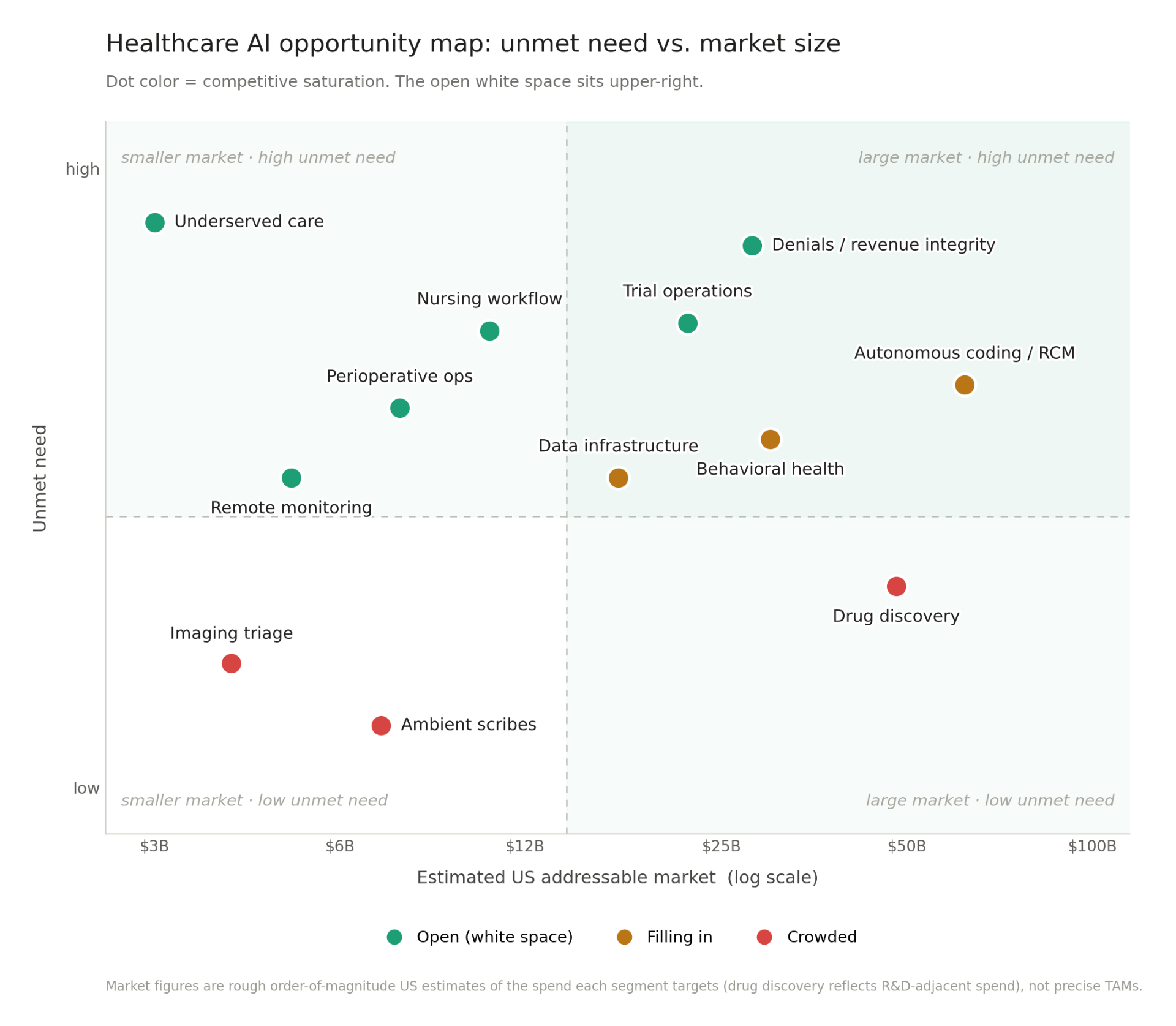
Two patterns surface immediately. The first: the celebrated categories, ambient scribes and imaging triage, actually sit low on the chart, because the need left is thin and the competition is dense. The second is the trap in the bottom-right. A huge market with little unmet need isn’t an invitation; it’s a knife fight already underway, which is exactly where capital-hungry, fiercely contested drug discovery sits. A large TAM is not the same thing as an opening.
Now the encouraging pattern. The truly open ground is the upper-right quadrant: big markets with sharp, unaddressed need and few, if any, AI-native companies that have reached both proof and scale. That territory isn’t where the hype is. It’s the administrative and workforce plumbing of healthcare. One qualifier, though: even that quadrant isn’t evenly open. Autonomous coding, for instance, is already “filling in” and sits further along the saturation curve than denials, which remain the most wide-open of the large back-office markets.
The clearest opening: denials and revenue integrity
Begin with the segment that scores well on every axis. Revenue cycle management in the U.S. is a market north of $65 billion, and inside it, claim denials are the fastest-growing source of pain. Hospitals now spend somewhere in the range of $18 to $20 billion a year simply reversing denials, one slice of the roughly $43 billion they sink into chasing money they’re already owed. Initial denial rates have climbed toward 12 percent and keep rising, and a striking share of denied claims, by some counts more than half, are never resubmitted at all. That’s revenue that simply evaporates.
Look at how this work actually gets done today: mostly by hand, over fax lines, with staff reconciling payer rules across systems that don’t talk to each other. The entrenched competition is legacy services, not software, let alone AI. There’s no regulatory gate to pass through, and the person writing the check is a finance leader staring at an obvious return, not a clinician you have to win over one skeptic at a time.
One dynamic deserves respect: this is an arms race. The moment providers point AI at appeals, payers point AI at denials, so anything that merely drafts appeal letters is a commodity destined to be neutralized. The defensible version reaches deeper: wiring directly into EHRs and clearinghouses, and predictive denial prevention that surfaces problems at scheduling and documentation, before a claim ever leaves the building. Compete on prevention and integration depth, not on letter-writing. Land that and you hold the rare full house: a large market, acute pain, an obvious buyer, and a real moat, sitting in plain view inside the billing office.
Where else the room is
Nursing and allied-health workflow. Nearly all documentation AI was designed around physicians, yet nurses make up the largest part of the clinical workforce and stay structurally neglected by physician-first vendors. But “neglected” isn’t “empty,” and the gap is closing quickly: ambient leaders such as Nuance and Abridge are pushing into nursing documentation, and Epic, the system of record beneath most large health systems, is shipping native generative AI for nursing handoffs and shift changes. Beating incumbents who own the EHR home field takes more than transcription. The opening lives in task prioritization, easing cognitive load, and virtual nursing models, the parts of the job that documentation alone never reaches.
Clinical trial operations and decentralized trials. Recruitment and retention have been chronic chokepoints for decades, pharma’s budgets run deep, and most of the category is still propped up by legacy process. Investors routinely flag it as one of the least-penetrated pockets of healthcare AI.
Perioperative and surgical operations. Operating-room throughput, scheduling, and staffing are enormous cost centers still managed largely by gut feel and whiteboards. The need is high, the field is thin, and large systems will gladly pay for measurable improvement.
Autonomous medical coding. Total U.S. spend on medical coding runs past $20 billion a year, that’s the prize, even though the AI-specific slice automating it is still only a few billion dollars, climbing fast as the work shifts from computer-assisted coding toward full automation. In practice the space is already contested, with well-capitalized players like Fathom, CodaMetrix, and SmarterDx holding real ground, it’s the “filling in” dot on the map for good reason. The window is narrowing rather than gaping, so a newcomer needs a sharper wedge than a general-purpose autonomous coder. The edge that’s left is the genuinely hard part: complex inpatient coding and DRG validation, where models still strain to reason across thousand-page charts, not tidy outpatient ICD-10 tagging. Go after the hard chart, not the easy one.
Healthcare data infrastructure and interoperability. The least glamorous layer, and the most durable, but also famously hard to sell as a lone startup, since health systems balk at onboarding yet another data vendor and would rather handle it natively or lean on established names like Redox, Health Gorilla, Databricks, or Innovaccer. The sharper wedge isn’t “we’ll tidy your data.” It’s LLM-ready contextual pipelines, turning unstructured clinical notes into accurate, queryable vector embeddings or graph structures that every AI application stacked above can draw on securely. Sell the AI-ready substrate, not the pipes. On the map it lands dead center, because it’s the gravity well that holds every other application in orbit.
Build for rural and underserved populations, but solve the payment model first
This is among the largest pools of real unmet need anywhere on the map, and it warrants genuine focus rather than a passing mention. Tens of millions of people, across rural areas, communities short on clinicians, and households whose first language isn’t English, pick their way through fragmented care. AI that widens access, such as multilingual virtual triage, proactive outreach, and care navigation that adapts to language, takes aim at a problem that unmistakably matters.
The hard part here isn’t the population; it’s how anyone gets paid, and the cleanest path to workable economics is value-based care (VBC). A lot of this care flows through Medicaid, Medicare Advantage, community health centers, and risk-bearing arrangements rather than ordinary fee-for-service, and under value-based contracts the incentives finally point your way. A triage tool that steers a rural patient clear of a needless $10,000 emergency-room trip isn’t a cost to absorb; that avoided spend lands directly on the provider’s bottom line. The founders who win here wire the reimbursement path into the product from day one, partnering with risk-bearing groups, managed-care plans, and federally qualified health centers whose incentives already reward better outcomes at lower total cost of care. Get that alignment right and impact and durability reinforce each other; defer monetization and even a superb product can struggle to keep the lights on. It’s a thornier commercial puzzle than the back-office segments, which doesn’t make it a smaller one.
A founder’s test for any healthcare AI idea
Before you commit to a concept, run it through six questions:
- Has anyone here already reached both clinical validation and commercial scale? If so, the door may have closed.
- Is the market big enough that a few percentage points of it still adds up to a real company?
- Who actually signs the check, and is the payoff obvious to them without a drawn-out pilot? A finance buyer with a clear number beats a clinician who might come around.
- Is there a regulatory hurdle you must clear, and does it become a moat that shields you later, or just a tax that slows you down now?
- Is the problem stiff enough to scare off dabblers, yet still within reach of a focused team inside twelve to eighteen months?
- Does it fold invisibly into the workflow the user already runs, or does it demand real behavior change? In healthcare, anything that forces a clinician into a new browser tab tends to die quietly. Seamless integration beats a better standalone tool.
The strongest healthcare AI ideas going right now clear all six, and most of them are nowhere near the exam room. They’re in the back office, on the nursing floor, at the trial site, and down in the data plumbing. That’s where the next category-defining companies are likeliest to take shape, for the plain reason that far fewer people are looking there.
Market figures are rough, order-of-magnitude estimates of the U.S. spend each segment targets, not precise TAMs. Competitor and funding references reflect public reporting available as of mid-2026.